In the recent Forgefriends webinar Cory Slep of Go-Fed and speaker at the webinar referred to working on the project as ‘gardening’ instead of ‘maintaining’. Nick Sellen, another speaker, chimed in to say that he’d adopt the term for his project Karott (where the fit is even more perfect). Gardening is a very appealing term, and allows a different perspective on the software development. “Maintenance” implies the project is more or less done and just needs to be upheld. But in reality it continues to evolve in all kinds of ways.
For a side-project of mine, innercircles, I already bumped into “Communty Digital Garden” as a concept to explore, and I made some notes that I will copy below.
I would like to explore the concept further and see if it can be turned into a nice ‘recipe’ to be included in the Social Coding practitioners guide.
Community Digital Gardening
(The nice thing is that the idea of an ‘organic garden’ as analogy also fits with evolution and growth as applied to innercircles)
Quoting from the article:
What is a Community Digital Garden?
Wikipedia: A community garden is a single piece of land gardened collectively by a group of people.
Joel Hooks: The phrase “digital garden” is a metaphor for thinking about writing and creating that focuses less on the resulting “showpiece” and more on the process, care, and craft it takes to get there. A garden is usually a place where things grow.
When you build a community digital garden you are building a mini searchable powerhouse for your niche and you can become the first place that people go to search for information.
Howto maintain a community digital garden?
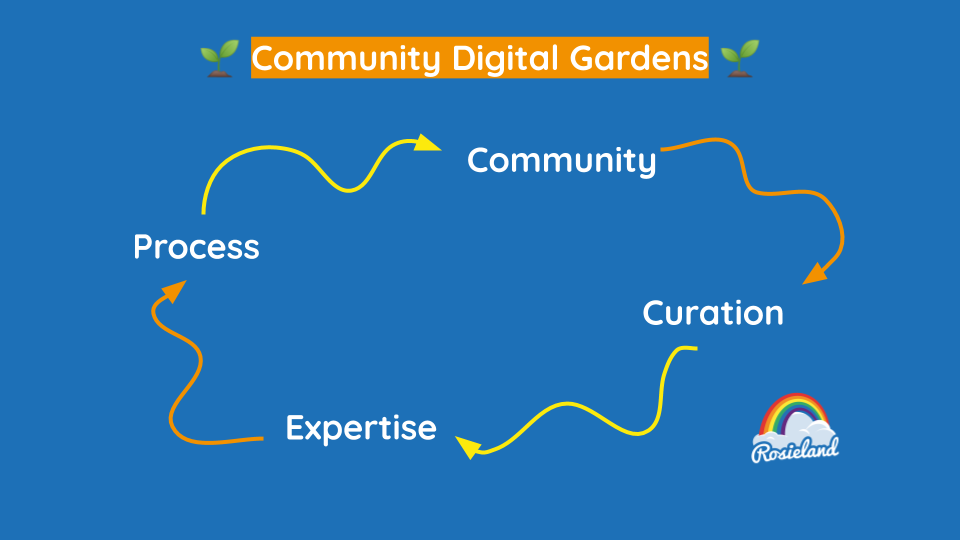
When I think about what is needed to maintain a community digital garden, I think of these things:
the need for curation: the world moves fast, there needs to be a way to constantly stay on top of what is happening in your industry
the need for expertise: we need to be constantly tapping into people and their knowledge
the need for a process: just like a business, a community digital garden will die a death if there isn’t some kind of process to keep it in place.
and of course, the need to build community around all of these things
I spend most of my days tending to my garden. I walk around it aimlessly, plucking dead links, pruning superfluous words, and repotting overgrown paragraphs into their own articles. I neglect some sections and obsess over others.
I accept that my work will remain unfinished. I am eager to discover what the soil can produce, but there are only so many hours in a day. I already marvel at how far it has come.
I have learned to welcome other gardeners as peers, instead of fearing them as competitors. I have learned to share advice and compliments freely. The world needs more gardens.
This article is a seedling. I might tend to it later, when it feels right. Kind regards to Maggie Appleton, who introduced me to this metaphor.
The website by Maggie Appleton is a great resource to consult:
Given the need for successful #FreeSoftware projects to be lovingly cared for and maintained by their community, instead of referring to them as a “project” we might call them:
“That’s what I want from my products. I want to putter about, feel connected to the process, and have fun doing so. I want to make things that don’t scale. To see people tuck into them and enjoy them as people, not as stats. [..] Something I can spend time on because I want to. Being able to talk to and interact with the people using my tools is fulfilling. Spending time meticulously improving subtle aspects of the product is enjoyable.”
These are great cultural aspects to be fostered in any Free Software project.
Not directly related to software projects, but Erlend’s blog post about Communal Bonfires highlights some interesting characteristics and needs when bringing forum-like and chat-like channels together.
The blog also mentions the Commune project based on Matrix protocol that will have ActivityPub support as well. This blog post is part of a series detailing a Community OS Stack that Erlend intends to incorporate as a Calm Fund company.
Update 2023-10-06: Erlend writes about “Cozy Community Software” that forms the “Cozy Web”: