This post relates to discussions on FEP Process sustainability on the SocialHub forum.
This is a partial copy for note-taking here in follow up to SocialHub discussion. If minds are open to it, the FEP may be a showcase for elaborating the concept of SX Sustainability criteria, and the processes to monitor them all the time.
See: 🫂 Commons custodians. Help increase FEP Sustainability and progress - Fediverse Enhancement Proposals - SocialHub
From which I created this call for participation on the fediverse.
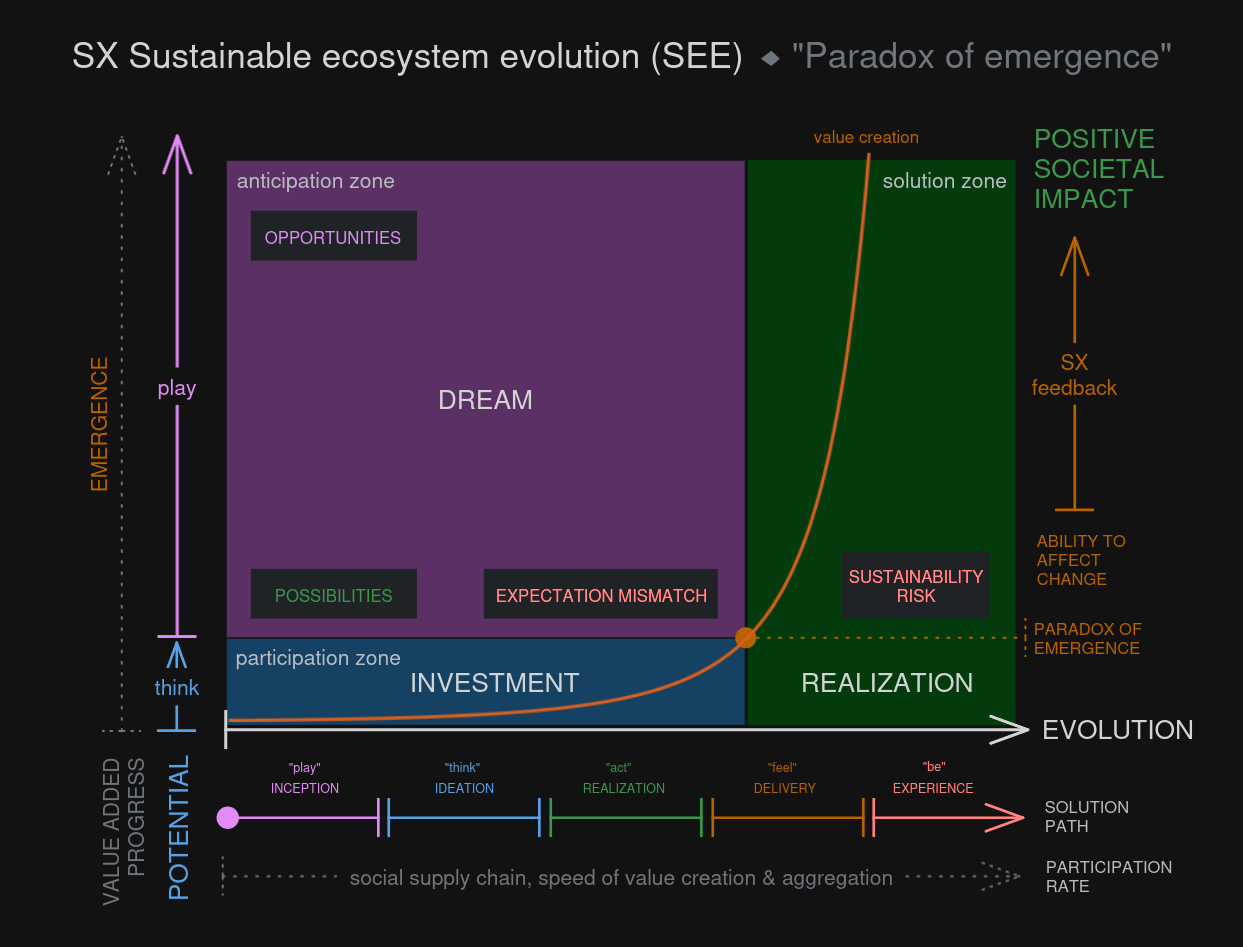
Click to expand the Alt-text to the diagram.
The diagram shows an exponential ‘value creation’ graph, with on the X-access the progress of evolution along the solution path. Below the axis the various lifecycle stages of the fediverse service delivery lifecycle are listed: Inception, Ideation, Realization, Delivery, Experience. Rate of value creation & aggregation of the social supply line depends on participation rate.
On the Y-axis is the Potential of the solution design, where value-add of investment in the solution depends on how emergent design leads to desired outcomes. It is not easily perceived as it exists mostly still in emergent space.
Diagram has 3 quadrants. On the bottom left the participation zone is where prolonged Investment is asked, while only little value can be demonstrated in the field. The biggest part above the participation / investment zone is the anticipation zone, where we dream and find possibilities and related opportunities that may have great potential. Expectation mismatch is a risk as the emergent value is stil invisble to most people.
The paradox is solved at an inflection point along the evolution axis of the solution, called appropriately ‘the paradox of emergence’ point, when actual value is demonstrated by positive societal impact that grows via SX feedback loops. This is the solution zone, the full right side of the diagram, where value creation can grow exponentially and dreams turn to their realization. Now there are sustainability risks to healthy evolution to monitor well.
I love  the great work that @silverpill and @helge have done to further the quality and overall process that allow people to submit and pursue Fediverse enhancement proposals (FEP’s). Taking over from others in the editors team, who are currently inactive, they managed to turn the FEP into the most relevant body of work for ActivityPub developers to consult to make interoperability happen on the wire. There are many ideas to make FEP stronger and even more supportive to healthy evolution of the fediverse, and I encourage anyone to contribute and lend their 2 cts or more to their realization.
Biggest challenge in a chaotic commons is to find the sweet spot between grassroots growth, formalized open standards catching up with that, and the level of standards compliance in the ecosystem that guarantees sufficient levels of interoperability that helps keep the ecosystem attractive, accessible, and the open standards a good choice for technology decision makers to adopt.
Commons janitoring, gardening the commons, is the term Social experience design (SX) uses for the people who do this important work. A key concept. Doing the boring chores that keep things together is crucial, and underappreciated work. The emergent design of SX has adopted the SEE model, for Sustainable ecosystem evolution. The model has only been created a few days ago, to be nurtured and evolve in the same way all concepts do under SX emergent design.
All is currently running smoothly I am assured, but the discussion on “Grassroots fediverse evolution” raised questions and differences of opinion on the long-term sustainability of the FEP process, that I want to address in this thread. Are there sustainability risks for the FEP …
- In one year, 5 years, 10 years? What is the vision, the outlook on the FEP?
- Come drastic popularity of fediverse, corporate capture threats, Big Tech entrants?
- Regarding how grassroots standardization efforts relate to official W3C standardization?
- Regarding bus factors of and supporting the needs of the FEP editor team?
- Regarding acceptance of the FEP across the ecosystem, and increase adoption?
- Regarding governances, division of roles and authority, as well as ownership?
- Is there divergence and fragmentation in the ecosystem, lack of cohesion to address?
There may be zero problems on the horizon, and the conclusion may be “All is well”, sustainability wise. If that is the case, under SX, we can say that sustainability criteria are met. Under SX monitoring sustainability is an ongoing process. Are FEP’s sustainability criteria well-defined, or can they be improved?